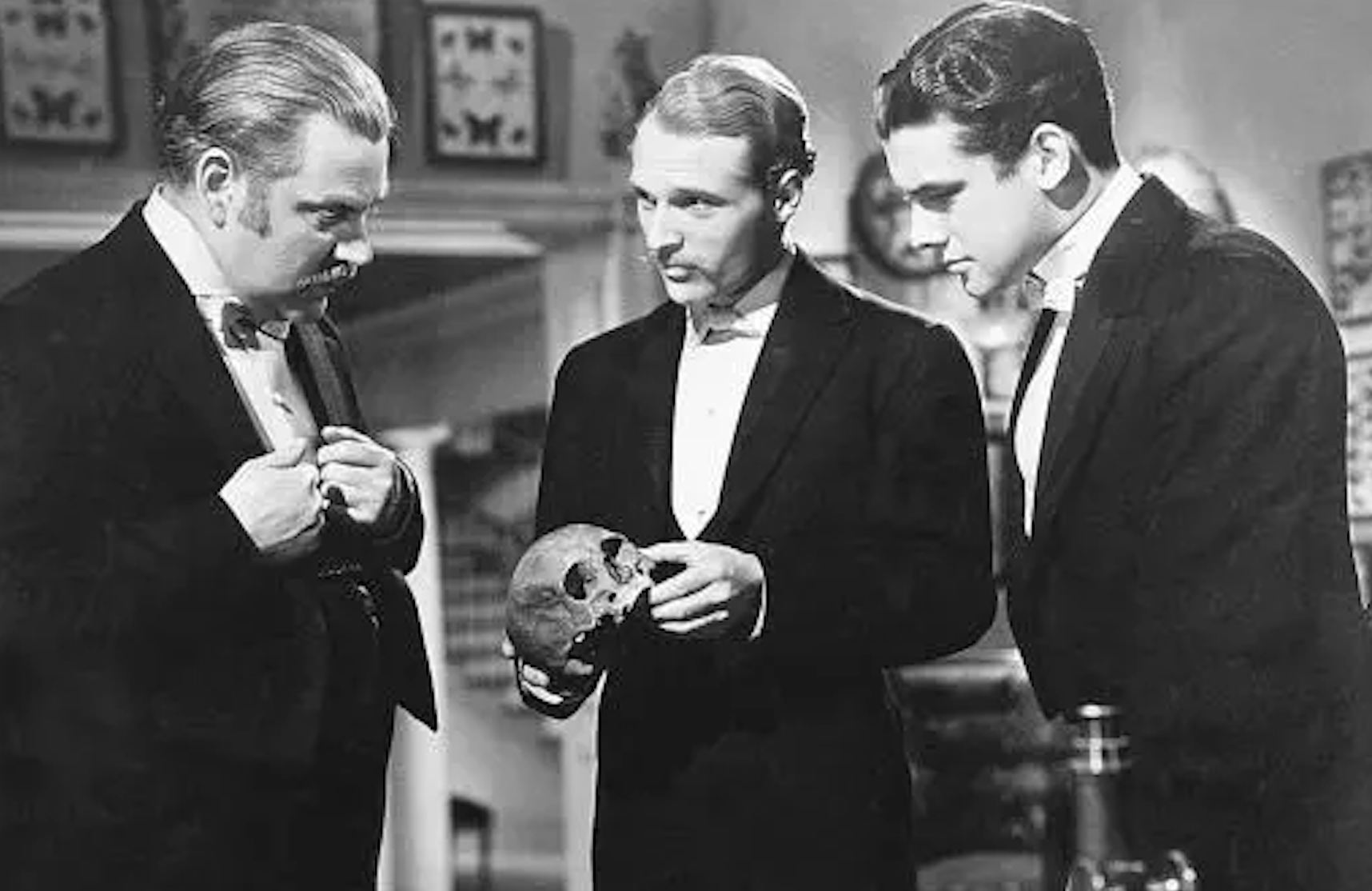
The British actor appeared in some of the most successful films of the early 1940s — yet, like many, discovered that stardom could be painfully fleeting.
With his suave demeanour and aristocratic tones, Morton Lowry brought a chilling edge to his role as John Stapleton in The Hound of the Baskervilles (1939). The film — the first pairing of Basil Rathbone and Nigel Bruce as Holmes and Watson — was a major success, and Lowry’s performance crackled with quiet menace. It would have been reasonable to assume that a star-spangled career lay ahead.
Instead, within a few short years, Lowry had all but vanished from cinema screens, leaving behind only scattered traces of a once-promising career.
Early Life and The London Stage
Information about Morton Lowry remains surprisingly scarce, even now. He was born Edward Morton Lowater in Lancashire in February 1914. His father, Edward Morton Lowater Sr., worked as an engineer, and soon after Morton’s birth the family relocated to London’s Russell Square — an affluent and fashionable area in the early decades of the twentieth century. His mother, Bertha Holmes Lowater, was a homemaker, and Morton grew up alongside his sister Kathleen.
London suited him. Rather than follow his father into engineering, Morton gravitated toward the stage. His good looks and refined manner eased his entry into the profession, initially through chorus work and revues at venues such as the Alhambra, Astoria, and Garrick theatres, performing under his birth name.
He married young, tying the knot with Diana Whalley in 1934 at just twenty years old. By 1936 the marriage had ended, but professionally Lowry was gaining momentum, steadily building a reputation as a reliable and charismatic performer.
Breakthrough: The Hound of the Baskervilles
By 1940, Lowry’s life had changed dramatically. He had remarried — this time to diamond heiress and socialite Virginia Barnato — and become a father. More significantly, he had secured the role that would define his screen legacy: John Stapleton in The Hound of the Baskervilles.
Using the name Morton Lowry, he injected a sinister elegance into a film already steeped in fog, fear, and Gothic menace. His performance provided much of the story’s underlying unease, complementing Rathbone’s razor-sharp Holmes and Bruce’s genial Watson. Lowry became one of the few actors to recur within the fourteen-film Holmes series, later appearing memorably in Pursuit to Algiers (1945), which boasts one of the series’ most effective twists.
Prestige Films and Memorable Roles
Away from Sherlock Holmes, Lowry appeared in one of the most celebrated films of the decade: How Green Was My Valley (1941). The film received ten Academy Award nominations and won five, including Best Picture — famously beating Citizen Kane and The Maltese Falcon. Lowry played Mr Jonas, the schoolmaster, in a cast that included Walter Pidgeon, Maureen O’Hara, and Roddy McDowall. Regardless of modern reassessments, it cemented his association with prestige productions.
Perhaps his most haunting performance came in Albert Lewin’s The Picture of Dorian Gray (1945). As Adrian Singleton, Lowry embodies moral and physical decay with heartbreaking precision. His scenes — particularly those set amid the squalor of Bluegate Fields — are among the film’s most atmospheric. Dishevelled, haunted, and broken, Singleton serves as a living warning of Dorian’s corruption. It is a small role, but a vital one, and Lowry plays it beautifully.
A Career Unravels
By the late 1940s, however, Lowry’s trajectory faltered. His second marriage ended around 1947, and his personal life seemed increasingly unsettled. From this point on, his story becomes frustratingly opaque. He married again, had another child, and divorced once more. At some stage he appears to have returned to Britain, later attempting — unsuccessfully — to revive his American career in the 1960s.
His final American film appearance came in 1947, uncredited, as a frightened man in Calcutta. Thereafter, his work shifted largely to British television. One of his most substantial later roles was as a Lieutenant in The Adventures of Robin Hood (1959–60), appearing in at least twelve episodes.
The Final Years
After a career that began with considerable promise and quietly dwindled, Morton Lowry died of heart failure following surgery in 1987 at a UCSF hospital in San Francisco. He was buried by the state at Pleasant Hills Cemetery — a stark and sobering end for an actor who once appeared in some of the finest films of his era.
That detail is perhaps the saddest part of this story. It is a life that encompassed both remarkable fortune and profound hardship. Whether it serves as a cautionary tale is difficult to say — too much of Lowry’s inner life remains hidden.
In Memoriam
What remains clear is the quality of his work. Morton Lowry enhanced every film he appeared in: villainous as Stapleton, enigmatic as Sanford the steward in Pursuit to Algiers, and devastating as Adrian Singleton. For lovers of classic cinema, he is not forgotten.
Those of us who cherish old films never truly let anyone die. Let this article stand as a small memorial to Morton Lowry — to what he achieved, and to the hope that, somewhere along the way, he found moments of joy in the profession he so clearly enriched.
Don’t forget to follow Celluloid and the City on social media for more classic Hollywood, film history and cinematic discoveries. Come and join the conversation — we’d love to see you there.
Leave a Reply