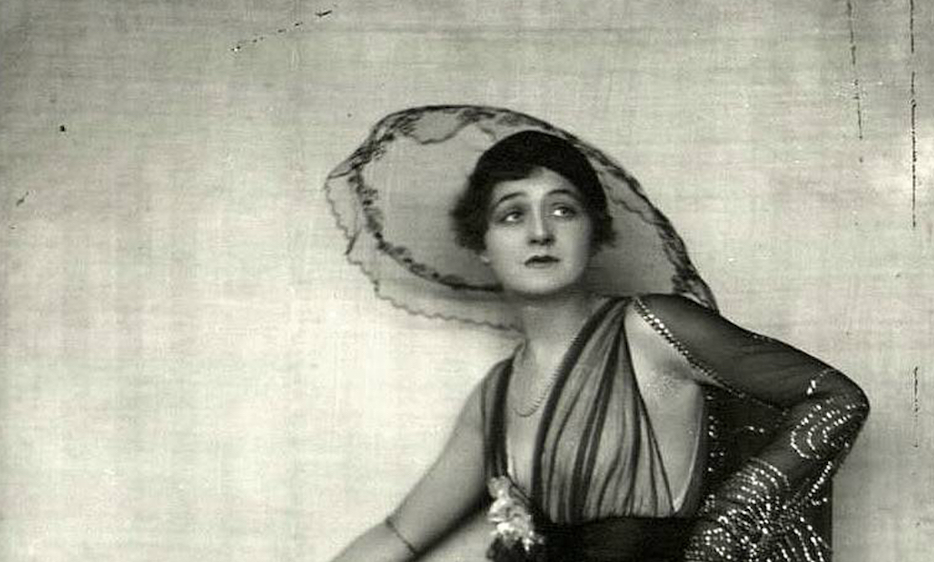
Her fortunes on the stage had been mixed. Some were charmed by her looks. Others were unimpressed by her ‘thin’ vocals. She’d been through a tough patch; she’d jumped on board Houp La! but that had closed within a week of her joining the production.
But things may have been starting to look up. She was due to start in a lead role in The Freedom of the Seas at the Haymarket Theatre, which would make her the youngest leading lady in London’s West End.
But now Billie Carleton was dead. At the age of 22. And her death would echo down the ages, inspiring a story by the world’s most-loved crime authors, and later of a global television adaptation.
Rumours of Billie Carleton’s drug use were legion within the industry. Theatre impresario CB Cochrane had fired her from one of his productions because he had heard reliable rumours that she had been attending ‘opium parties’. Though he later rehired her for the aforementioned Houp La!, the actress’s behaviour apparently did not abate.
Maybe it was the instability of her theatrical background, with its highs and lows. Or the fact that she had a left home at fifteen and had been largely unsupervised in a bustling London. Or maybe she was embracing the liberation of flapper culture, casting off the corsets and inhibitions of previous generations and really living. Whatever the reason, Billie Carleton lived fast. And this fast living was to reach a ghastly crescendo on the evening of 27th November 1918.
Billie and her friend Reggie De Veulle were guests at the Victory Ball at the Royal Albert Hall, which was a grand event commemorating the end of the World War One. The event carried on into the wee small hours of the morning, and Billie danced and caroused with the most luminous luminaries from the aristocracy and London society. Everything was amazing – the war ‘to end all wars’ was over. London was ready to shine again. There was much to celebrate.
At some point, Billie Carleton left this illustrious gathering. And was never seen alive again.
It was her maid who found her, in her bed, at The Savoy hotel. She had taken a massive overdose of cocaine. Billie Carleton’s fast life had caught up with her, at the tragically young age of 22.
Reggie De Veulle was charged and convicted of conspiracy to supply a prohibited drug to his friend and sentenced to eight months in prison. Many sordid details of Billie’s private life were revealed during the course of the trial, with De Veulle coming in for much criticism. Cross-dressing and blackmail were thrown into the mix, painting him as a devil who corrupted an ‘innocent girl’. Far from judging Billie for her fast ways, in death she was sanctified by the public as someone who merely got in with the wrong crowd. The press at the time, unlike today’s gutter raking press, maybe had an eye on how exposure to such wretched evidence in court could affect a nation with a more delicate constitution than today.
Of course, such a dramatic event was ideal fodder for writers, with Noel Coward admitting, having known both Carleton and Reggie De Veulle, that the case was the inspiration for his first play The Vortex. The case also piqued the interest of the ‘Queen of Crime’ Agatha Christie, who wrote the affair into her first published short story The Affair of the Victory Ball in 1923. The story was adapted for the screen in 1991, as part of the celebrated Poirot series with David Suchet as the Belgian sleuth. Christie’s Coco Courtney, the character inspired by Billie Carleton, meets the same end, but Christie weaves a murder plot around one of the other characters and makes a compelling case around an already historically compelling one. Carleton was immortalised in art. Reggie de Veulle passed away in 1956. His designs for the costumes for the 1926 stage musical Yvonne are in the archive of the Victoria & Albert Museum. A book of his ‘revelations’ promised to a French publisher in 1933 were never realised.
Sometimes life is even more dramatic than what is portrayed in a book or on the screen. Billie Carleton’s short life and notorious death shows that sometimes you can have too much drama and altogether too much notoriety.
Leave a Reply