
This beautiful blonde captivated through WWII and the Korean War. But stardom was fleeting and a sign of the times.
The 1940s and 1950s were a bumper time for beautiful blondes, as we well know, with only a select few – Marilyn Monroe, Grace Kelly, Anita Ekberg – making it to the top tier. Some made the climb look easy, which often masked a journey to the top that had been fraught with rejection and worse. Sometimes beauty blinded in a way that it was hard to ascertain where genuine talent actually lay, under layers of fluff and frippery.
Marilyn Maxwell was one of these. While she never made the top tier, she had all of the attributes that should have propelled her to the top of the pecking order. Her tragically early death at age fifty led many to wonder what could have been if circumstances had been different.
Maxwell was born Marvel Marilyn Maxwell on August 3rd, 1921. She worked as a theatre usher in her hometown of Clarinda, Iowa, in the 1930s, later dropping out of high school in her sophomore year to join a band in Indianapolis as a singer. She moved into engagements as a radio singer and a singer on stage with Ted Weems’s big band while she was still in her tender teens. But she had ambition, and it was ambition that was going to take her far away from Clarinda, Ohio. She was soon singing for USO Shows for American servicemen, and became a popular fixture, before moving to Hollywood to try her hand at movie stardom, in between spots entertaining the troops, first in World War Two, and then Korea. She was soon signed up to a contract by MGM, and began to appear in films – the first being the star-studded World War II propaganda film Stand by for Action (1942) – while also keeping up her radio work on such shows as The Abbott and Costello Show and Beat the Band.
Blessed with a beautiful voice, and an effervescent nature, Maxwell thrived on-screen, and was soon appearing in potentially career-making roles with some of the most famous stars of the 1950s – Lost in a Harem (1944) with Abbott and Costello; Champion(1949) with Kirk Douglas; The Lemon Drop Kid (1951) with Bob Hope; New York Confidential (1955) with Broderick Crawford; and Rock-A-Bye Baby (1958) with Jerry Lewis. During the 1950s, like many stars realising which way the future lay, Maxwell directed her attentions to television work with guest appearances on such series as The Colgate Comedy Hour (1950), General Electric Theater (1953), The Red Skelton Show (1951), The Tennessee Ernie Ford Show (1956), and Playhouse 90 (1956).
During the 1950s she met the entertainer Bob Hope, who was married to singer Dolores Reade, and began a four-year affair with him, which was such an open secret in Hollywood that she was known by many as ‘Mrs Bob Hope’. In the 1940s, she had also had an affair with Frank Sinatra, which was called off after the singer’s wife, the long-suffering Nancy Barbato Sinatra. The oft-told story goes that Mrs Sinatra had noticed a diamond bracelet in the glove compartment of her husband’s car and thought that it was a present for her until young Ms Maxwell attended the Sinatra’s Christmas gala with the very same bracelet on her arm. Maxwell, on the arm of her first husband John Conte, was ushered from the gala by an incandescent Mrs Sinatra, which had the effect of severing the connection between Maxwell and the chronic love cheat Sinatra, who had the unfortunate habit of wanting to jump any young woman with a pulse. On being compared to that other beautiful blonde Marilyn Monroe, Maxwell quipped ‘I’m the blonde with her clothes on’. Nevertheless, the gossip columns sopped this up like biscuits soak up tea.
Maxwell was married three times but found no success in the arena of love once these, and her highest profile affairs ended. Her television work took her up to the 1960s, and she had also revived her singing career, performing in some of the highest profile nightclubs in New York. But the movie roles had dried up following such a promising start, as they had for so many disillusioned performers. One of her most high profile television roles of this period was that of a diner owner in the show Bus Stop in 1961. she quit this show after one season, due to feeling it was a very limited part. A close friend of Rock Hudson, after her third marriage ended, Hudson’s agent fixed up a false relationship between Hudson and Maxwell, one of many ‘lavender’ relationships that were confected to disguise Hudson’s homosexuality.
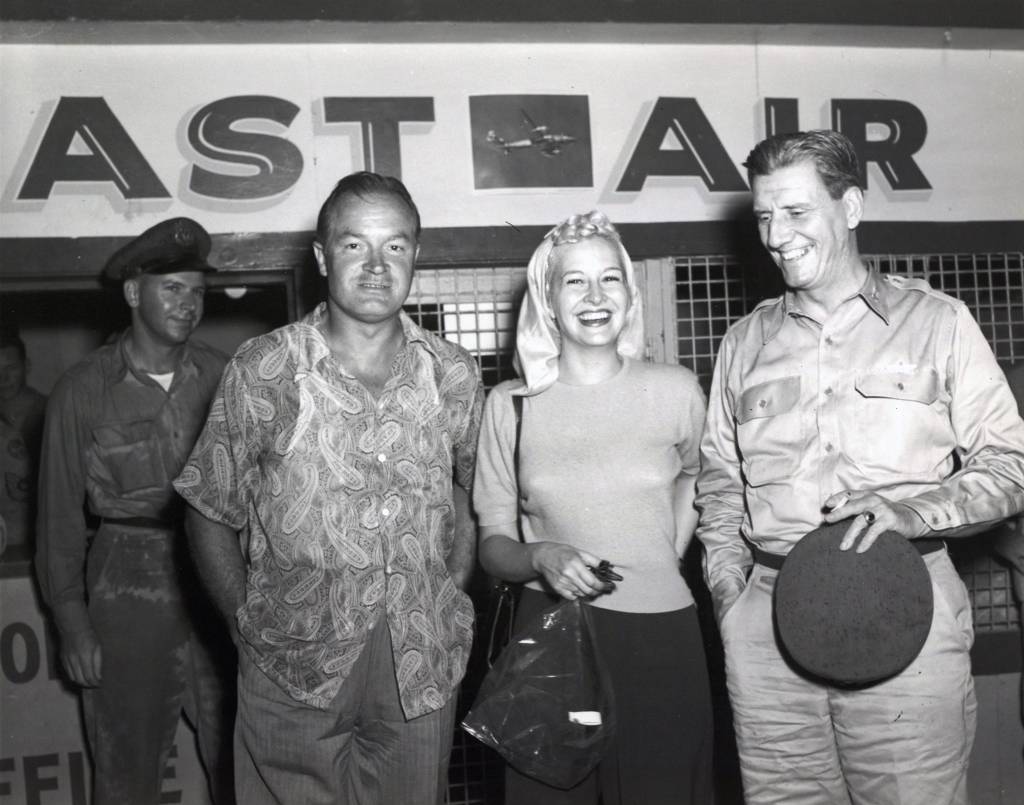
Stardom is a fickle thing, and even critical plaudits can only take one so far once the wheel of fortune has started to turn the other way. Somehow, in spite of beauty and a willingness to turn her hand to anything, Maxwell’s star started to wane in the 1950s. Many stars and starlets have been on that journey, and it is one of the most soul-destroying and unpredictable things that can happen. The studio system was in its dying days, and this allowed many to slip through the cracks if they hadn’t been built up to significant level, or could transcend their original billing. We don’t even know for sure how the ‘other’ Marilyn would have navigated the 1960s. The cruelty being that when many women feel that they are at the height of their powers, they become dispensable. Even beautiful Hollywood blondes with genuine talent.
Minor roles in minor films took Marilyn Maxwell through the 1960s, but nothing took her close to the days when she was at the top of the pile again. Other blondes came and went, and a fickle public soon forgot.
Marilyn Maxwell was found dead of an apparent heart attack by her only son Matthew Davis on March 20th 1972, at the age of 50. Her knack of being able to hold the crowd and keep eyes upon her is evident in her movie work, which is still a joy to watch and shows her to be full of joy, and most importantly, talent. Make time to familiarise yourself with her and her work. There is definitely room in the movie canon for two Marilyns.

 Celluloid & the City